

What is structural health monitoring?
Structural health monitoring (SHM) is the process of applying a damage-identification strategy to civil, aerospace and mechanical infrastructure — by tracking changes in the material and geometric properties of the structure over time.
Why monitor
Reduce uncertainty
Owners often lack reliable data on material condition, actual loads and aging. Monitoring supports informed decisions — and can lower insurance costs.
Reveal hidden reserves
Most structures are in better condition than assumed. Monitoring can safely extend service life or load capacity and defer repair costs.
Detect deficiencies early
Some defects can't be found by visual inspection or modeling. Catching them early is cheaper and less disruptive.
Ensure long-term quality
Continuous quantitative data assesses quality during construction, operation and maintenance — including defects that appear only years later.
Manage structures
Reliable data lets owners spend on maintenance and rebuilding when it's needed — not only when budgets allow.
Improve knowledge
Real-world performance data supports performance-based designs that are cheaper, safer and more durable.
Reference project: San Giorgio Bridge, Genoa
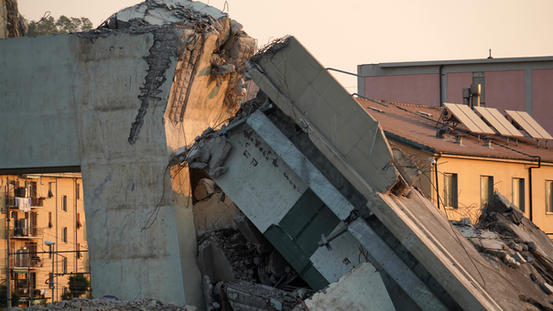


The Morandi bridge in Genoa collapsed on 14 August 2018. Its replacement, the San Giorgio bridge, was completed in April 2020 and instrumented with two high-sensitivity tilt sensors on each pier and pier foundation — monitoring settlement, traffic and wind loads, temperature and misalignment.
Fiber optic sensors were selected for their high reliability and long service life, as electrical sensors and cabling are more fragile.
Instrument your structure
We support system design, sensor selection, field installation and data acquisition.