
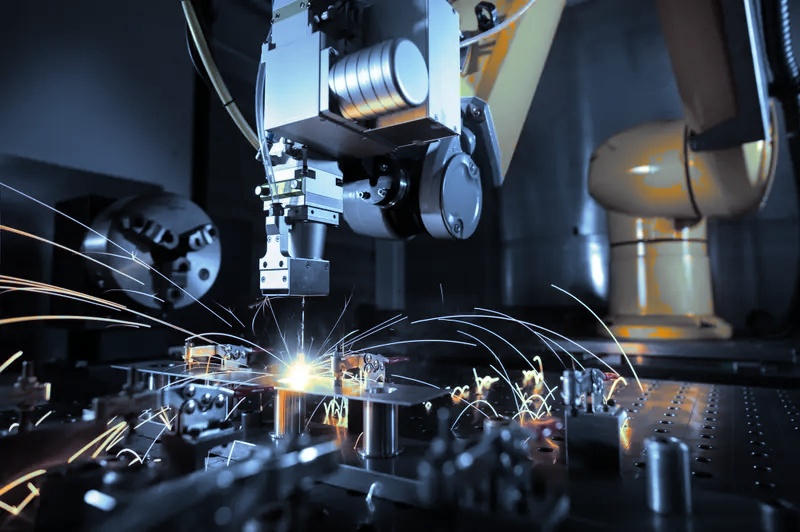
Why laser welding
Compared with conventional welding methods, laser welding creates deeper and narrower welds with a bright, clean seam. High power density melts the material quickly with low heat input — enabling higher welding speeds, less thermal distortion and lower stress outside the weld zone.
Welding methods
Galvanometer (scanner) welding
Computer-controlled scanner mirrors move the beam at high speed, welding with high precision from a distance.
Spot welding
High-energy pulses on a small spot diameter join sheets of the same or different thickness and material — common in automotive bodies, containers, metal frames and cabinets.
Penetration welding
The weld forms by heat conduction — or the beam passes through a transparent top layer, such as plastic, to join the material beneath.
Oscillation (wobble) welding
The beam oscillates along the seam, increasing gap tolerance and reducing the effect of porosity.
Power control makes the weld
Precise control of laser power — especially at the start and end of the weld — is critical to quality. Absorption and reflection change as the material passes through each melting stage; ramping the power gradually achieves high weld quality with a single laser source.
CW fiber laser sources, 1–20 kW
With laser–machine integration and process support for your welding application.