
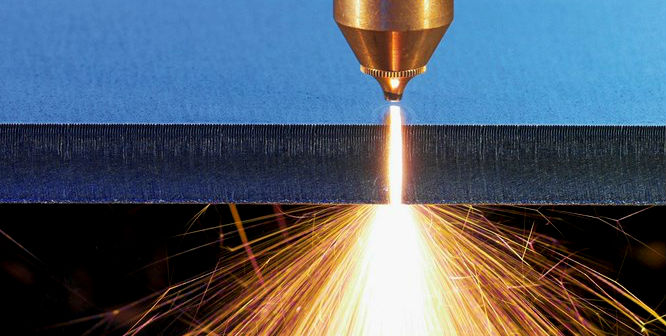
Fiber lasers and their advantages
Fiber lasers belong to a family known as “solid-state lasers”, in which the beam is generated by a solid medium. Fiber lasers, disk lasers and Nd:YAG lasers all fall into this category.
A fiber laser beam is generated by an array of laser diodes and focused into the fiber. Beams from many laser diodes are combined with fiber combiners and pump the active fiber, where the light is amplified. The amplified beam is carried through a delivery cable called a QBH to the cutting head, where optics reduce the beam diameter and focus it onto the material.
Fiber laser sources offer the following advantages:
Unlike a conventional CO₂ resonator, a fiber laser source has no moving parts (such as fans for gas circulation) and no mirrors in the light-generating source — a major advantage for reducing maintenance requirements and operating costs.
Fiber lasers are typically two to three times more energy-efficient than CO₂ lasers of the same power.
A fiber laser cuts thin sheet faster than a CO₂ laser of the same power, because the fiber laser wavelength is better absorbed by the material being cut.
Thanks to back-reflection protection, fiber lasers cut reflective and bright materials without stopping the process and without damage to the laser source (resonator) — so copper, brass and aluminum can be cut without problems.
How laser cutting works
Laser cutting is a thermal process. A focused laser beam melts the material in a small, localized area, and a coaxial gas jet blows the molten material out of the kerf. A continuous cut is produced by moving the laser beam or the workpiece under CNC control.
Three cutting methods
Fusion cutting
An inert assist gas such as nitrogen expels the molten material from the kerf, leaving clean, oxide-free edges.
Flame cutting
Oxygen is used as the assist gas. Its exothermic reaction with the material adds energy to the cutting process.
Remote cutting
Thin materials are partially vaporized by the high-intensity beam — no assist gas is required.
Cutting systems
Laser sources are integrated into three-axis flat-bed cutting machines and into 3D cutting cells, where six-axis robots are programmed with offline CAD/CAM software. With continuing gains in precision, edge squareness and control of heat input, laser cutting is increasingly replacing plasma and oxy-fuel profile cutting.
CW fiber laser sources, 1–20 kW
Plus QBH and cutting-head integration and cutting-parameter tuning by our engineers.